Shopping Cart
How to Choose a Bass Guitar: Number of Strings, Scale Length, Pickups and Amp
- 5 min read
- Vytautas Gaponovas
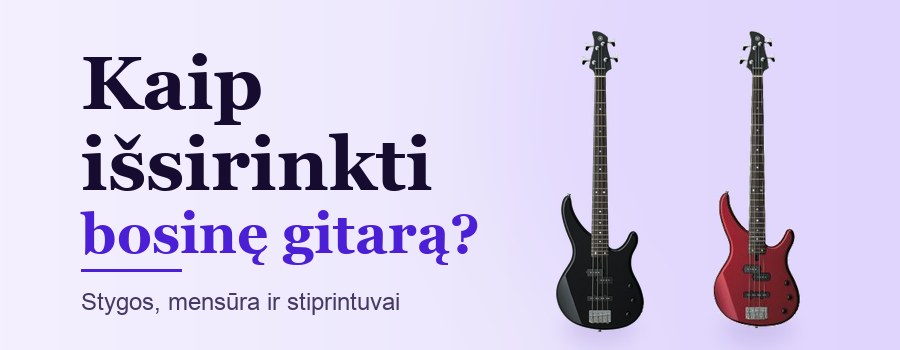
How to Choose a Bass Guitar?
The bass guitar links rhythm and harmony: it “glues” the drums to the guitars and keys. A good bass should be comfortable, stay in tune and sound clear even when the band is playing loud. Here's what to look out for when choosing your first – or next – bass.
Where to start?
Start with your musical style and the size of your hands. A classic 4-string bass suits almost any music, while 5-string models come in handy for heavier music, gospel or modern pop, where lower notes are needed.
A bass guitar needs a bass amp – a guitar amp can't reproduce low frequencies and may be damaged.
4 or 5 strings?
The 4-string bass (E–A–D–G) is the standard most bassists start on. The neck is narrower, making it easier to learn your first bass lines.
The 5-string bass has an extra low B string. It extends the range downwards, but the neck is wider and playing cleanly is more demanding.
For beginners we usually recommend a 4-string bass: once you've learned the basics, you'll get the hang of a 5-string quickly.
Scale length – the key to comfort
Scale length is the length of the strings from the nut to the bridge. Most bass guitars are long scale (34 inches). It's the standard, giving a clear, strong low-end sound.
Short-scale (30–32 inch) basses are lighter and more compact, with the frets closer together. They suit children, players with smaller hands and those who also play guitar.
Scale length comparison
30–32 inchesShort scale: frets are easier to reach, comfortable for younger bassists.
34 inchesStandard scale: the most common choice, the classic sound.
35 inchesExtra-long scale: common on 5-string basses, gives a clearer low B string.
Pickups and electronics
Precision Bass (P) style pickup – a strong, “meaty” midrange sound that cuts through the band perfectly. Simple and reliable.
Jazz Bass (J) style pickups – two single-coil pickups for a brighter, more detailed sound with more tonal shades.
A PJ combination brings both together and is one of the most versatile choices.
Active electronics (battery-powered) have a built-in EQ and a stronger signal, while passive ones are simpler, need no batteries and sound more natural.
Bass amp
For home and practice, a 15–40 W bass combo is enough. For rehearsals with a drummer you'll need at least 100 W or a more powerful amp with a bigger speaker.
It's handy if the amp has a headphone output and an AUX input – you can play along with recordings quietly.
Popular bass amps
Browse the categories
Construction: bolt-on or neck-through, fretted or fretless
A bolt-on neck is the most popular construction: durable, easier to adjust and to repair if needed. It's known for a brighter, punchier sound.
A neck-through runs the full length of the body – notes sustain longer and the upper frets are easier to reach. These basses tend to be more expensive.
A fretless bass sounds smooth and “singing”, but demands a precise ear and intonation. For beginners we recommend a fretted bass.
Bass strings
Roundwound strings give a bright, ringing sound and are the most popular. Flatwound strings are smooth, with a mellower, “vintage” sound and less finger squeak.
Bass strings last longer than guitar strings, but once they lose their clarity the sound becomes muddy. When changing strings, take the scale length into account – a long-scale bass needs long-scale strings.
For beginners, a bass guitar pack with an amp, cable, strap and gig bag is a convenient choice – all the parts are chosen to work together.
What to avoid when choosing a bass guitar
- Plugging a bass into a guitar amp – you risk damaging the speaker.
- Choosing a 5- or 6-string instrument just because “more is better”.
- Forgetting the strap and gig bag – a bass is heavier, so you'll need a good strap from day one.
Frequently asked questions
Is the bass easier to learn than the guitar?
Getting started is often simpler, since the bass plays single notes rather than chords. But having a solid sense of rhythm and locking in tightly with the drums is a skill of its own that takes practice.
What size bass guitar is right for a child?
Short-scale (30–32 inch) basses are more comfortable for children and teens – they're lighter and the frets are closer together.
Can a bass guitar be plugged into a guitar amp?
Briefly and at low volume – yes, but we don't recommend it. A guitar speaker isn't designed for low frequencies and can be damaged.
What is an active bass guitar?
An active bass guitar has a built-in preamp and EQ powered by a battery. You can shape the sound right on the guitar, and the signal is stronger.
Conclusion
For your first bass guitar, choose a comfortable 4-string instrument with P, J or PJ pickups and a bass amp with the right amount of power.
At the Muzi.lt shop we offer bass guitars, amps, strings and accessories. If you have any questions, get in touch – we'll help you choose.