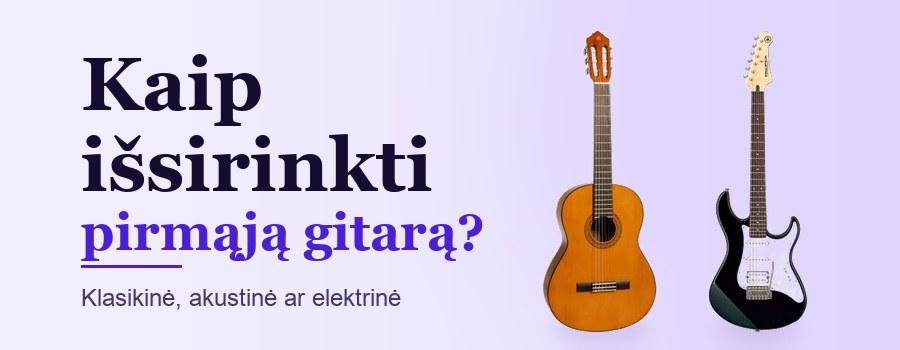
How to Choose a Guitar for Beginners: Classical, Acoustic or Electric?
4 min read
Vytautas Gaponovas
How to Choose Your First Guitar?
Wanting to play guitar is a great start, but the choice in a shop can make your head spin. Which guitar is best for a beginner? Does a child need a smaller one? How much should you spend? In this updated guide we answer the most important questions.
Where to start?
Choose a guitar based on the music you want to play. A classical guitar suits learning and classical music, an acoustic is for campfire songs and accompaniment, and an electric is for rock, blues and pop.
Above all, the guitar should be comfortable and well set up. Even the most expensive instrument won't bring any joy if the action is too high and your fingers hurt.
Nylon strings are soft and easy on the fingers, and the sound is warm. The classical guitar is what most music schools teach on. Classical guitars also come in smaller sizes for children.
Steel strings sound louder and brighter, and the narrower neck is comfortable for chords. It's the most popular choice for anyone who wants to sing and play popular songs. Read more in the guide How to choose an acoustic guitar.
Light-gauge strings and a slim neck make chords the easiest to fret. You will, however, need an amp. For beginners, a pack that includes an amp is a convenient choice. Read more in the guide How to choose an electric guitar.
Besides the guitar, budget for a case, a tuner, spare strings and a stand – and for an electric guitar, an amp and a cable. For beginners it's handy to choose packs that already include these accessories.
Investing in a reliable entry-level instrument pays off: a well set-up guitar is easier to play and sounds better, and that's the biggest motivation in the first few months.
How to learn guitar
Start with a few basic chords (Em, Am, C, G, D) and a simple strumming pattern.
Practise every day for 15–20 minutes – consistency matters more than duration.
Use a metronome to keep your rhythm steady.
Pick songs you love – your motivation will last longer.
What you'll need besides the guitar
A tuner – without one, the guitar will quickly go out of tune.
A case – protects against knocks and moisture.
Spare strings and picks.
A stand – a guitar that's always within reach ends up in your hands more often.
If you'll be studying at a music school – a classical guitar. If you want to sing popular songs – an acoustic. If rock or blues is your thing – an electric with an amp.
At what age can a child start playing guitar?
Usually from 5–7 years old, on a smaller-sized classical guitar. What matters most is the child's enthusiasm and an instrument of the right size.
Is it worth buying the cheapest guitar?
Very cheap guitars are often poorly set up – the strings are hard to press down, so beginners quickly get discouraged. It's worth choosing entry-level models from reputable makers.
Conclusion
Your first guitar should be comfortable, the right size and well set up. At the Muzi.lt shop we offer classical, acoustic and electric guitars for beginners and advanced players, and you can try the guitars on display at our showroom in Marijampolė.
Acoustic, classical or electro-acoustic? We explain body shapes, differences in tonewoods and what to look for so your guitar is comfortable and sounds great.
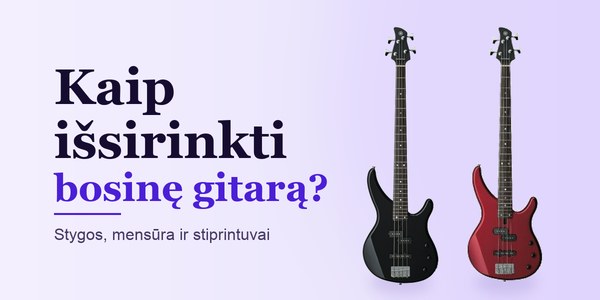
The bass guitar is the foundation of a band. We explain the difference between 4- and 5-string models, what scale length means, the types of pickups and why a…