Shopping Cart
Acoustic or Digital Piano? Pros, Cons and How to Choose
- 7 min read
- Edvinas Gurevičius
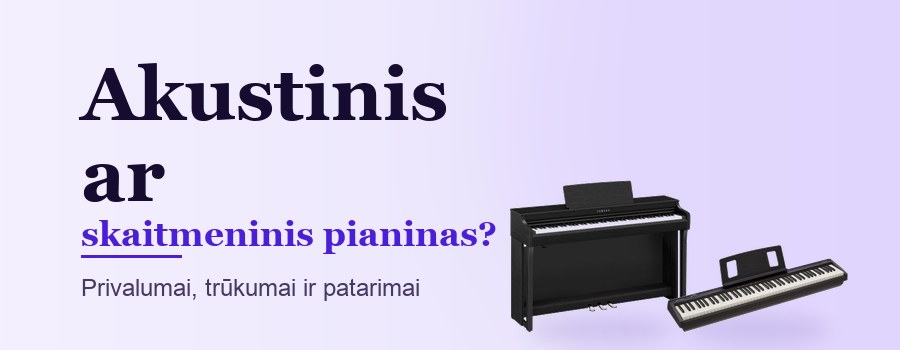
Acoustic or Digital Piano?
The question “acoustic or digital?” often sounds like a debate between tradition and technology. In reality, it's much simpler: what matters most is what you get for your budget. Most families aren't choosing between a new concert instrument and a digital one, but between an old used piano and a new digital one. In this article we compare them honestly.
Where to start?
Before choosing, answer three questions: where will the instrument stand, and will playing disturb your family and neighbours? What are your goals – learning, music school or performing? And what's your budget?
Acoustic piano: which one are we really buying?
In an acoustic piano, sound is produced by hammers striking the strings, and the wooden body resonates. But not all acoustics are equal. For €500–1000 you'll usually get a used instrument that's several decades old – a Soviet-era RIGA, for example. Its action is worn, the keys respond unevenly, the sound is dull, it doesn't hold its tuning well, and moving it is no easy job – it can take three or four strong people.
New acoustic pianos are a different story altogether. Entry-level models such as the YAMAHA b1 start at around €4,000, while higher-end instruments with superb sound and action, such as the YAMAHA U1, cost about €10,000 and up. They're mostly chosen by classical musicians and performing pianists, as well as people living in detached houses, where the instrument can stand in a separate room without disturbing anyone.
The modern digital piano
A digital piano plays sampled sounds of concert grand pianos. In the YAMAHA Clavinova CLP series, for example, you'll hear the YAMAHA CFX and Bösendorfer Imperial grands. Such a piano sounds cleaner and more pleasant than most old acoustic instruments.
For a pianist, though, the keyboard matters more than the sound: how the hammers respond to the fingers and how the subtlest nuances come across. On the best models, such as the YAMAHA Clavinova CLP-885, the keyboard rivals the action of a grand piano, so you can even prepare for concerts on such an instrument. It's no coincidence that even performing pianists often practise at home on a high-end digital piano – you can play it at any time of day or night.
Console digital pianos look like an acoustic upright and come in various sizes. The cabinet helps the sound resonate, so the tone is close to that of an acoustic instrument, while all the advantages of a digital piano remain. Portable models are light and compact – easy to take to a rehearsal or a gig.
A digital piano is always ready to play: you can turn the volume down or use headphones, so even late in the evening your family and neighbours won't be disturbed.
Most popular digital pianos at Muzi.lt
Learning on a digital piano is more fun
On an acoustic piano, practice often becomes monotonous: the same exercises, the same sound, and after half an hour you no longer feel like playing. A digital piano works like a patient teacher and a whole orchestra in one, so you want to sit down at it again and again.
It's no coincidence that more and more music schools are choosing digital pianos too. The teacher records a piece and shares the file; at home, the student listens to it, mutes one hand's part and practises the other, then records their own playing and sends it to the teacher.
What you can only do on a digital piano
Each hand separatelyRecord the left-hand part and learn the right hand while it plays – or vice versa. In the built-in pieces, one hand can be muted.
AppsA tablet shows the notes and the keys to press, and the app tracks whether you're playing correctly.
Waiting for the right noteThe piano or its app waits until you press the right note before playing on. Many better models have this feature.
Lots of soundsSeveral concert grand sounds, organ, harpsichord, strings, electric piano – playing never gets boring.
Metronome and rhythmsA built-in metronome and accompaniment rhythms develop your sense of rhythm and turn exercises into a game.
Duets and headphonesTwo headphone jacks – teacher and student, or brother and sister, can play together without disturbing anyone.
Comparison
Acoustic vs digital
What you get for the priceFor €500–1000 – an old used acoustic or a new digital with a warranty. A new acoustic starts at ~€4,000, and higher-end models (e.g. the YAMAHA U1) cost about €10,000 and up.
Keyboard and soundA high-end digital sounds like a concert grand, and its keyboard rivals a grand piano's action. An old piano's action is often worn and its sound dull.
Silent practiceA digital piano can be turned down or played with headphones at any time of day; an acoustic can't.
How to choose
- An acoustic piano suits people living in their own house, where the instrument can stand in a separate room. You can't turn it down, so everyone at home hears you play – and in a flat, so do the neighbours.
- A digital piano suits anyone who wants to play at any time without disturbing others and to learn the modern way: with built-in learning features, each hand separately, with favourite songs or using external apps.
- Budget. A digital piano can cost anything from €300 to €8,000: the more expensive it is, the better the keyboard, sound and features. For a beginner student, families most often choose the most affordable YAMAHA Clavinova CLP series piano (currently the CLP-825), and on a smaller budget, more affordable ROLAND, CASIO or YAMAHA models.
Browse the categories
Frequently asked questions
Is it worth buying a used acoustic piano for €500–1000?
Usually not. For that money you typically get an instrument several decades old, with a worn action, uneven keys and a dull sound. A new digital piano at a similar price is better for learning – and much easier to sell if you ever need to.
Can you study at music school on a digital piano?
Yes. Many music schools are themselves upgrading and buying digital pianos. The usual choice is a model with 88 weighted hammer-action keys and at least one pedal – a YAMAHA Clavinova CLP series piano or a comparable digital piano from another maker.
Is it easier to learn on a digital piano?
Usually, yes: you can learn each hand separately while listening to a recording of the other hand's part, apps show you the notes and keys, the wait-for-note feature lets you learn at your own pace, and different sounds and rhythms keep things from getting boring.
What does a weighted keyboard mean?
It's a keyboard where the keys are heavier in the bass and lighter in the treble, just like on an acoustic piano. It helps you develop proper finger technique.
Conclusion
An old acoustic piano for €500 and a new one for €10,000 are completely different instruments – just like digital pianos at €300 and €8,000. So it's worth comparing what you actually get for your budget. If you're choosing between an old acoustic and a new digital piano, the answer is clear – go digital. And if you want to develop your technique seriously and your budget allows, choose the best digital piano you can.
A digital piano gives you flexibility, convenience and comfort while keeping all the charm of an acoustic piano. At the Muzi.lt showroom in Marijampolė (Kauno g. 15) you can try the digital pianos on display for yourself – come and visit, or get in touch by email at [email protected] or by phone at +370 645 08700, and we'll help you choose.