Shopping Cart
How to Choose a Digital Piano: Keyboard Action, Sound, Pedals and Connectivity
- 5 min read
- Vytautas Gaponovas
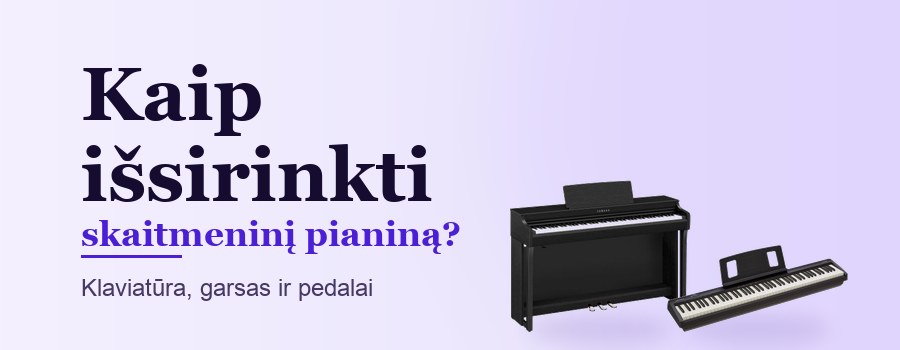
How to Choose a Digital Piano?
A digital (electric) piano is the most popular choice for home and learning: it's always ready to play, you can practise with headphones, and high-end models sound like a concert grand. We explain which features to look at.
Where to start?
The key question is where and how you'll play. Console models suit the home and learning, while portable ones are for gigs, rehearsals and smaller spaces.
The keyboard comes first
Choose an 88-key piano with weighted hammer-action keys. This kind of keyboard mimics the mechanism of an acoustic piano: the keys are heavier in the bass and lighter in the treble.
More expensive models offer an escapement feature and wooden or ivory-feel keys – playing them feels like the action of a concert grand.
Sound and polyphony
Sound quality depends on the sound source (sampled or modelled grand pianos) and the speakers. Console pianos usually have a more powerful and spacious sound system.
Polyphony is how many notes can sound at the same time. When you use the pedal, notes pile up quickly, so we recommend at least 64-note polyphony – ideally 128 or more.
Console or portable?
Console models look like an acoustic upright, have three pedals and a sturdy cabinet that helps the sound resonate, so they sound practically identical to an acoustic piano. They come in compact and various other sizes. The best choice for learning at home.
Portable models are light and can be set on a stand or a table. They usually have a single sustain pedal, and extra pedals can be connected.
Most popular console pianos
Browse the categories
Portable digital pianos
Compact, lightweight models suit smaller flats, students and those who play at events. It's worth adding a stand, a bench and headphones.
Most popular portable pianos
Connections and features
- Two headphone outputs – handy for lessons with a teacher.
- USB MIDI or Bluetooth – for apps and recording.
- Metronome, recording, different voices.
Useful accessories
- A stand and a height-adjustable bench.
- Closed-back headphones.
- A pedal (for portable models – a better sustain pedal).
Pedals
An acoustic piano has three pedals: sustain (right) – notes ring on longer, sostenuto (middle) – sustains only the notes being held down, soft (left) – makes the sound quieter and softer.
Console digital pianos usually have all three pedals. Portable models typically come with a basic sustain pedal – when learning, it's worth getting a piano-style pedal or a three-pedal unit if the model supports one.
Entry-level, mid-range and premium pianos
Entry-level models have weighted keys and a good-quality main piano sound – enough for the first few years of learning.
Mid-range pianos offer a more realistic keyboard, a more powerful sound system, more voices and more learning features.
Premium models (e.g. the YAMAHA Clavinova CLP-800 series) deliver the sound of concert grands, wooden keys, modelling of piano resonance, a powerful sound system and an elegant cabinet. A digital piano at this level sounds better than most acoustic pianos found in homes.
Browse the categories
A digital piano for a child
For a child who attends music school, choose a console piano with 88 weighted keys and three pedals. A height-adjustable bench matters too – good posture helps avoid tension in the arms and back.
Where to put a digital piano
- Place the piano away from radiators and direct sunlight – the electronics and cabinet like a stable temperature.
- Leave room for the bench and free arm movement – about 1 m in front of the keyboard.
- If the piano has speakers in the back, don't push it right up against the wall.
- Use headphones when playing in the evening – the neighbours won't hear a thing.
Frequently asked questions
How many keys should a digital piano have?
For learning we recommend 88 keys – the same as a standard piano, so you can play any piece.
What is polyphony?
It's the maximum number of notes that can sound at once. When you play with the pedal, notes build up, so it's worth choosing at least 64 – ideally 128 or more.
Can you play a digital piano with headphones?
Yes, all digital pianos have a headphone output – often even two.
What's the difference between an electric piano and a keyboard?
A digital (electric) piano is designed for piano sound and has weighted keys. A keyboard has hundreds of voices and auto-accompaniment, but usually light, unweighted keys.
Conclusion
Choose a digital piano with 88 weighted keys, enough polyphony and a format that suits you. At the Muzi.lt shop we offer console, portable and premium digital pianos, and you can try the models on display at our showroom in Marijampolė.