How to Choose a Keyboard: Number of Keys, Voices, Accompaniment and Learning Features
4 min read
Vytautas Gaponovas
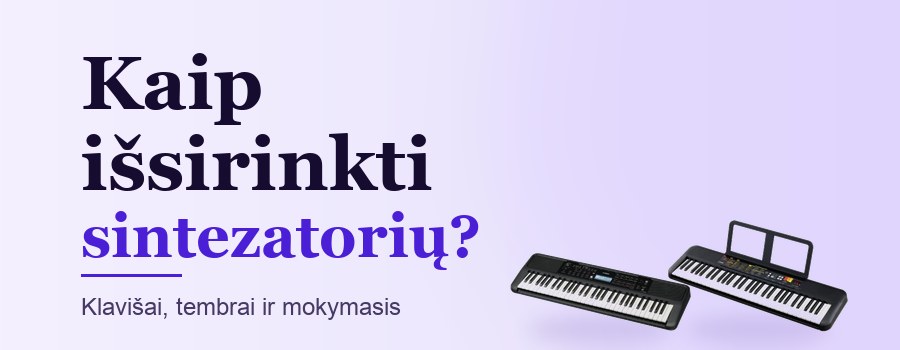
How to Choose a Keyboard?
A keyboard is a great first instrument for anyone drawn to the keys: it's light and has hundreds of voices and rhythms, learning features and a headphone output. But models vary a lot. We explain how to choose the right one.
Where to start?
First decide what the keyboard is for: introducing a child to music, teaching yourself, making music or playing at events. If your goal is to study piano seriously, it's worth choosing a digital piano with weighted keys.
For beginners we usually recommend a 61-key keyboard with full-size keys.
Number of keys
32–37 keysFor little ones – compact children's keyboards.
61 keysThe most popular choice for beginners and students.
76–88 keysWhen you want more range and to play piano pieces.
Touch-sensitive keys
A touch-sensitive keyboard responds to how hard you press: play softly and the sound is quieter, play harder and it's louder. This matters when learning to play expressively, so choose a model with this feature.
Voices, rhythms and learning features
Keyboards have hundreds of instrument voices and auto-accompaniment styles – you just play the melody and the keyboard “plays along” with you.
Learning features (lessons, a song bank, lighted keys on some models) and a USB port for apps help keep motivation up.
Little ones do well with compact children's keyboards with smaller keys and speakers. They're light, can run on batteries and the volume can be adjusted.
If the main thing is having fun making music, creating and trying out different instruments – choose a keyboard. If you plan to study piano seriously or attend music school – a digital piano. More in the article How to choose a digital piano.
How they differ
KeyboardHundreds of voices, rhythms and accompaniment, light keys, portable.
Digital pianoA realistic piano sound and weighted keys – for learning to play the piano.
Speakers, power and connections
Speakers – the more powerful, the fuller the sound; the built-in ones are enough for home.
Power – many models also run on batteries, so you can take the keyboard outdoors or on a trip.
USB port – for learning apps and making music on a computer.
Headphone and pedal jacks – for quiet practice and a more expressive sound.
Synthesizers for production and the stage
Musicians who make electronic music or play in a band will want synthesizers with sound editing, analogue synths, sound modules and drum machines. With these instruments, it's not the number of voices that counts but the sound-shaping options, controls and connections (MIDI, CV/Gate).
Beginner producers often find it easier to start with a MIDI keyboard and computer software, and add hardware synths to the studio later.
A sustain pedal – notes ring on longer, just like on a piano.
A power adapter, if one isn't included.
Frequently asked questions
From what age can you buy a keyboard for a child?
Children's keyboards with smaller keys make great gifts for kids as young as 3–5. For school-age children, a keyboard with 61 full-size keys is a better fit.
Can you learn piano on a keyboard?
The basics – yes. But keyboard keys are lighter, so for serious piano study we recommend a digital piano with weighted keys.
Does a keyboard have a headphone output?
Most keyboards have a headphone jack, so you can play quietly.
Conclusion
For a beginner, choose a 61-key keyboard with touch-sensitive keys and learning features; for little ones, a compact children's model. At the Muzi.lt shop we offer keyboards for all ages.
A used acoustic piano or a new digital one? We compare what you get for the same budget, how the keyboard and sound differ, and why learning on a digital piano…
88 weighted keys, polyphony, pedals and Bluetooth – we explain which digital piano features matter most and how to choose the right model for home or learning.
Have you ever dreamed of playing the piano or keyboard? With Yamaha and flowkey, one of the world's most popular piano learning apps, you can learn to play…