How to Choose a MIDI Keyboard and Controller for Music Production
3 min read
Vytautas Gaponovas
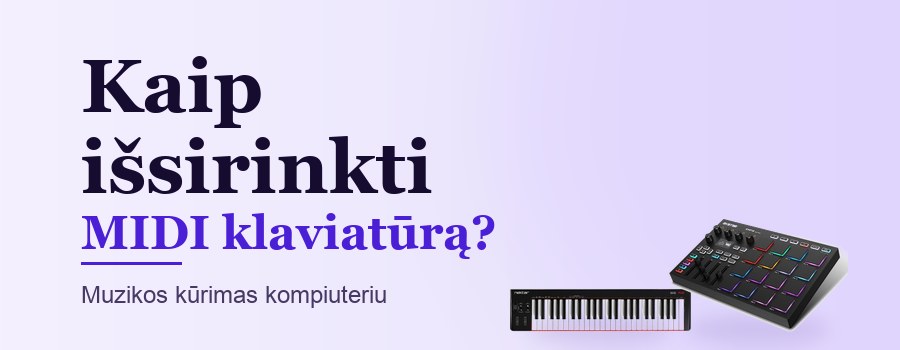
How to Choose a MIDI Keyboard?
A MIDI keyboard is an essential tool for making music on a computer. It makes no sound by itself, but controls virtual instruments, synths and effects. Here are the features that matter most.
Where to start?
A MIDI keyboard connects to the computer via USB, and the sound is generated by music production software (a DAW). To listen, you'll need headphones or studio monitors and, ideally, an audio interface.
25 keysCompact, fits on a desk and in a backpack – for beats and melodies.
49 keysVersatile: you can play with both hands.
61–88 keysFor piano and orchestral parts.
Pads, knobs and faders
Drum pads are handy for beats, while knobs and faders control effects and the mix. If you make electronic music, it's worth choosing a keyboard with pads.
Most MIDI keyboards have light, synth-action keys. If you plan to play piano parts, look for semi-weighted or weighted keys. Sensitivity to how hard you press the keys (velocity) also matters.
Software
Many MIDI keyboards come with a version of recording software and virtual instrument bundles – so you can start making music right away.
How to connect a MIDI keyboard
Connect the keyboard to the computer with a USB cable – most models work without extra drivers.
In your music software (DAW), select the keyboard as a MIDI input device.
Load a virtual instrument onto a track and start playing.
Listen through an audio interface with headphones or studio monitors – that keeps latency to a minimum.
Frequently asked questions
Does a MIDI keyboard make sound without a computer?
No. A MIDI keyboard sends control signals – the sound is generated by a computer, tablet or external sound module.
How is a MIDI keyboard different from a synthesizer?
A synthesizer has its own sounds and speakers, while a MIDI keyboard is only a controller. Most synthesizers can also work as a MIDI keyboard.
Do I need an audio interface?
Not for the MIDI keyboard to work, but it's recommended for good sound and low latency when listening.
Conclusion
For compact beatmaking, 25 keys with pads are enough; for all-round production, 49 keys; for piano parts, 61–88 weighted keys. At the Muzi.lt shop we offer MIDI keyboards, controllers and studio equipment.
Want to record vocals, guitar or a podcast? We explain what an audio interface is for, how many inputs you'll need and what to look for when choosing one.
For the stage, the studio or a podcast? We explain the difference between dynamic, condenser and USB microphones, what polar patterns mean and what else you'll…